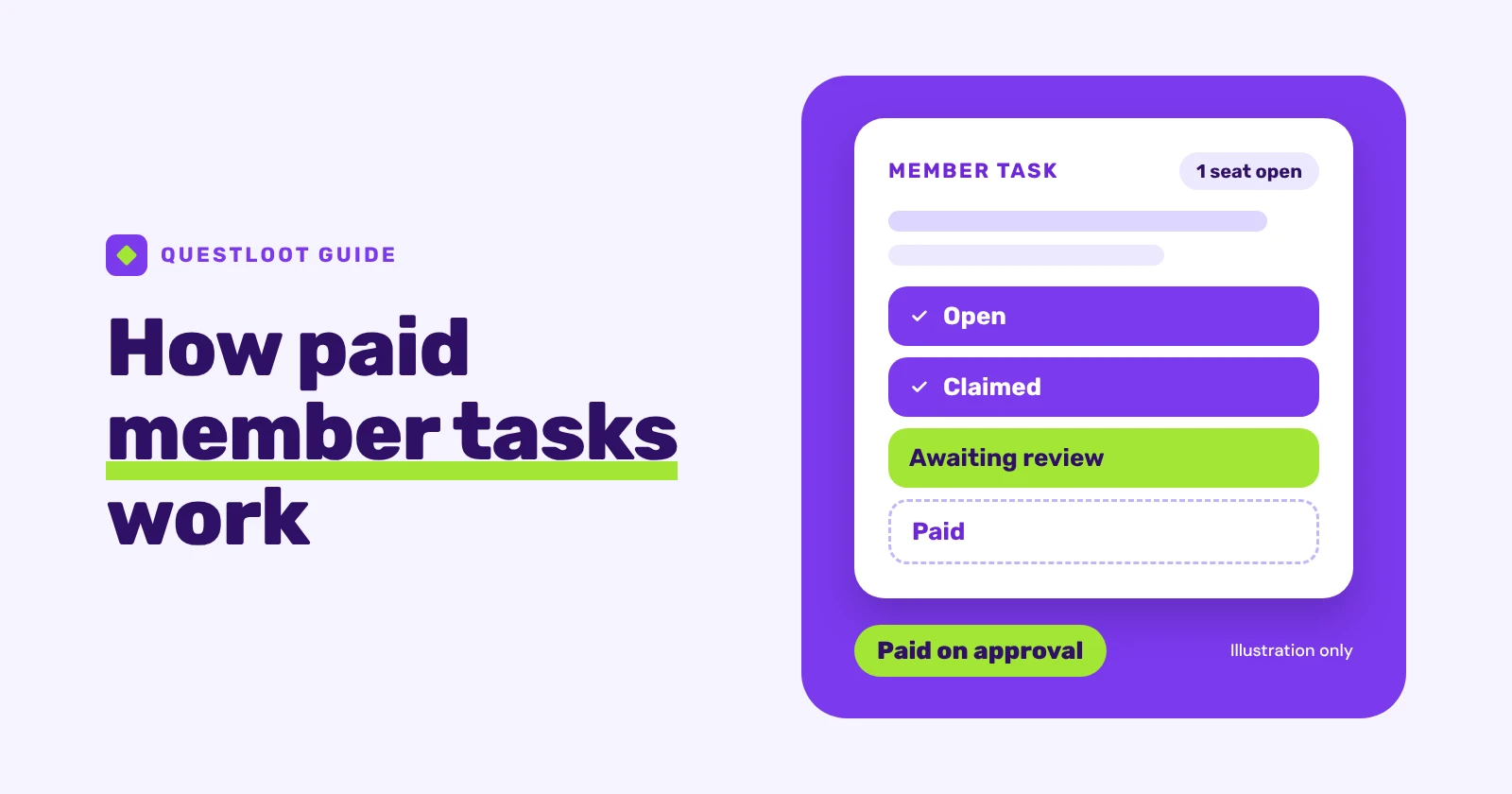
Paid member tasks are small jobs that one member posts and pays for, and another member completes. You claim a seat on a task, do what the instructions ask, send proof, and the payout is added to your balance once your proof is approved. Claiming a task costs you nothing, and the money comes from the member who posted it. You can see how this works on QuestLoot's member tasks page.
Tasks pay modestly, and each payout depends on a person approving your work. That's also what separates them from the "task scams" the FTC keeps warning about, where you're asked to pay before you can earn. This guide explains how member tasks work step by step, what happens when proof is denied, how to choose tasks worth your time, what posting a task involves, and how to tell a real task from a scam.
What are member tasks, and who pays for them?#
A member task is a small, one-off job, posted by someone who wants it done. Unlike game quests and surveys, it isn't an offer from an advertiser. On QuestLoot, the member who posts a task funds it from their own balance, not QuestLoot. The full payout is taken from their available balance when the task goes up and held until each seat is resolved, so the money for your seat is set aside before you start.
Each task has a set number of seats, a payout per seat and a time limit for finishing once you've claimed one. QuestLoot may also post some tasks itself. Which tasks are open changes all the time, and there may be only a few, or none, when you look.
How do you earn from a member task, step by step?#
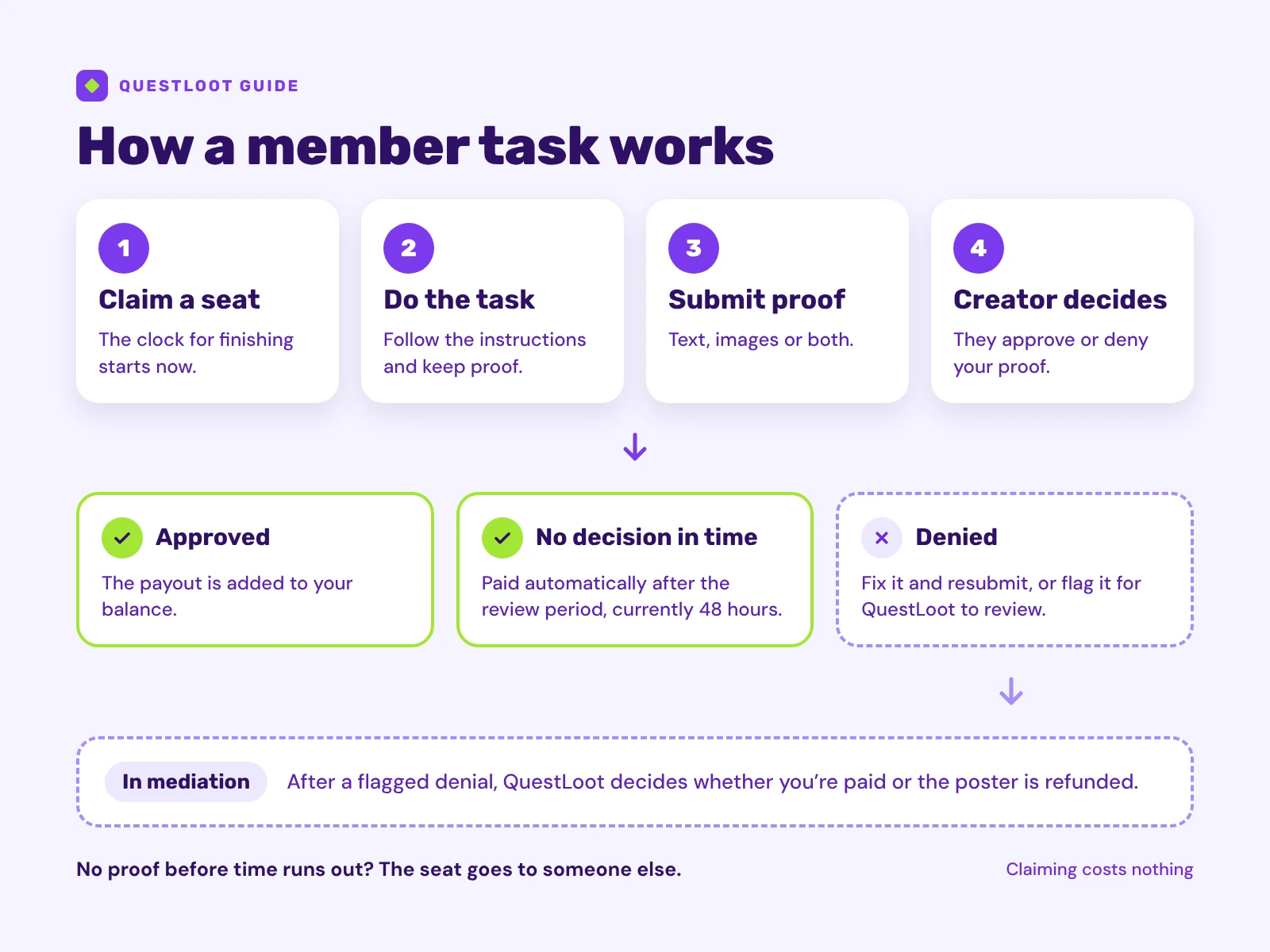 How a member task goes from claiming a seat to getting paid.
Step 1: Find an open task#
Once you're signed in, the tasks page lists open tasks with how many seats are left, the payout per seat and how long you'll have to finish. You need an account to claim one.
Step 2: Read the instructions before you claim#
The instructions are what your proof is judged against. Check exactly what the task asks for, what proof it wants, and whether you can finish within the time limit. If anything is unclear, pick a different task.
Step 3: Claim a seat#
Claiming reserves a seat for you and starts the clock. It doesn't get you paid on its own. If you don't send proof before the time runs out, your claim lapses and the seat goes to someone else.
Step 4: Do the task and keep your proof#
Do exactly what the instructions say. As you go, take the screenshots or notes you'll need to show what you did.
Step 5: Submit your proof#
Proof can be text, images or both. Describe what you did in plain words and add screenshots where they help, because the task's creator decides from what you send.
Step 6: Wait for a decision#
The creator approves your proof, which pays you, or denies it. If they don't decide within the review period, currently 48 hours, your proof is approved and paid automatically.
Once you're signed in, each seat shows a label such as one of these:
| Label you may see | What it means |
|---|---|
| Open | Nobody has claimed this seat yet. |
| Claimed | You've claimed it, and the clock for finishing is running. |
| Awaiting review | Your proof is in, and the creator has a set time to decide. |
| Denied | The creator denied your proof. See the next section. |
| In mediation | QuestLoot is reviewing a disputed decision. |
| Paid | Your proof was approved and the payout is in your balance. |
| Refunded | The seat's payout went back to the member who posted the task. |
What happens if your proof is denied?#
A denial isn't necessarily the end. Read the instructions again, fix whatever was missing, and submit your proof again. You can resubmit up to a limit.
If you think the denial was wrong, you can flag it and ask QuestLoot to review it. The seat then shows as In mediation while QuestLoot looks at both sides. Where a decision is disputed, QuestLoot decides whether you're paid or the creator is refunded.
Mediation works best when your proof makes the case for you. A clear description and screenshots that match each part of the instructions are far easier to judge than "done".
Which tasks are worth your time?#
Divide the payout by the minutes the task really takes, including reading the instructions, gathering proof, and any second attempt. Here's a made-up comparison of two tasks:
| Task (invented) | Payout | Minutes it really took | Payout ÷ minutes |
|---|---|---|---|
| A · clear instructions, one screenshot | $0.40 | 4 | $0.10 |
| B · vague instructions, resubmitted once | $1.00 | 20 | $0.05 |
Invented example. These aren't typical results or a benchmark.
Task B pays more on paper and half as much for your time, because the vague instructions cost a resubmission. A few checks help you spot the better task before you claim:
- Clear instructions. If you can't tell exactly what counts as done, the creator may not agree with your version.
- Simple proof. A task that needs one screenshot is easier to get approved than one with a long list of evidence.
- A comfortable time limit. Leave room for slow loading or a second attempt.
- Work you'd be happy to do. Skip anything that feels off, including any task that pays you to post a positive rating or like things. The FTC warns not to trust anyone who offers that.
If you'd rather work through offers from advertisers, our guides to earning with game quests and earning with online surveys explain how those pay.
What does it take to post a task?#
Posting works the other way round: you pay other members to do something for you. On QuestLoot:
- You complete a one-time identity check first. It's the same check needed before your first cashout.
- The payout comes out of your available balance when you post, and it's held until each seat is approved, paid or refunded. QuestLoot sets limits on the payout, the number of seats and the time to finish.
- You review the proof. Approve it to pay the member, or deny it if it doesn't match your instructions. If you don't decide within the review period, the proof is approved automatically.
- You can cancel seats nobody has claimed and get those funds back, but you can't cancel a seat someone has already claimed.
- You can't post a task for yourself, including through other accounts you control.
Clear, specific instructions save everyone time. Say exactly what counts as done and what proof you want.
How is a member task different from a task scam?#
The FTC describes task scams in two consumer alerts. Its December 2024 alert says scammers "ask you to do simple, repetitive tasks, such as liking videos or rating product images online," and that "nobody but the scammers make any money." Its 2025 guide to spotting task scams adds that scammers might "pay you a little" at first, usually $5 to $20, "to try to gain your trust," before telling you to deposit your own money, "usually in crypto."
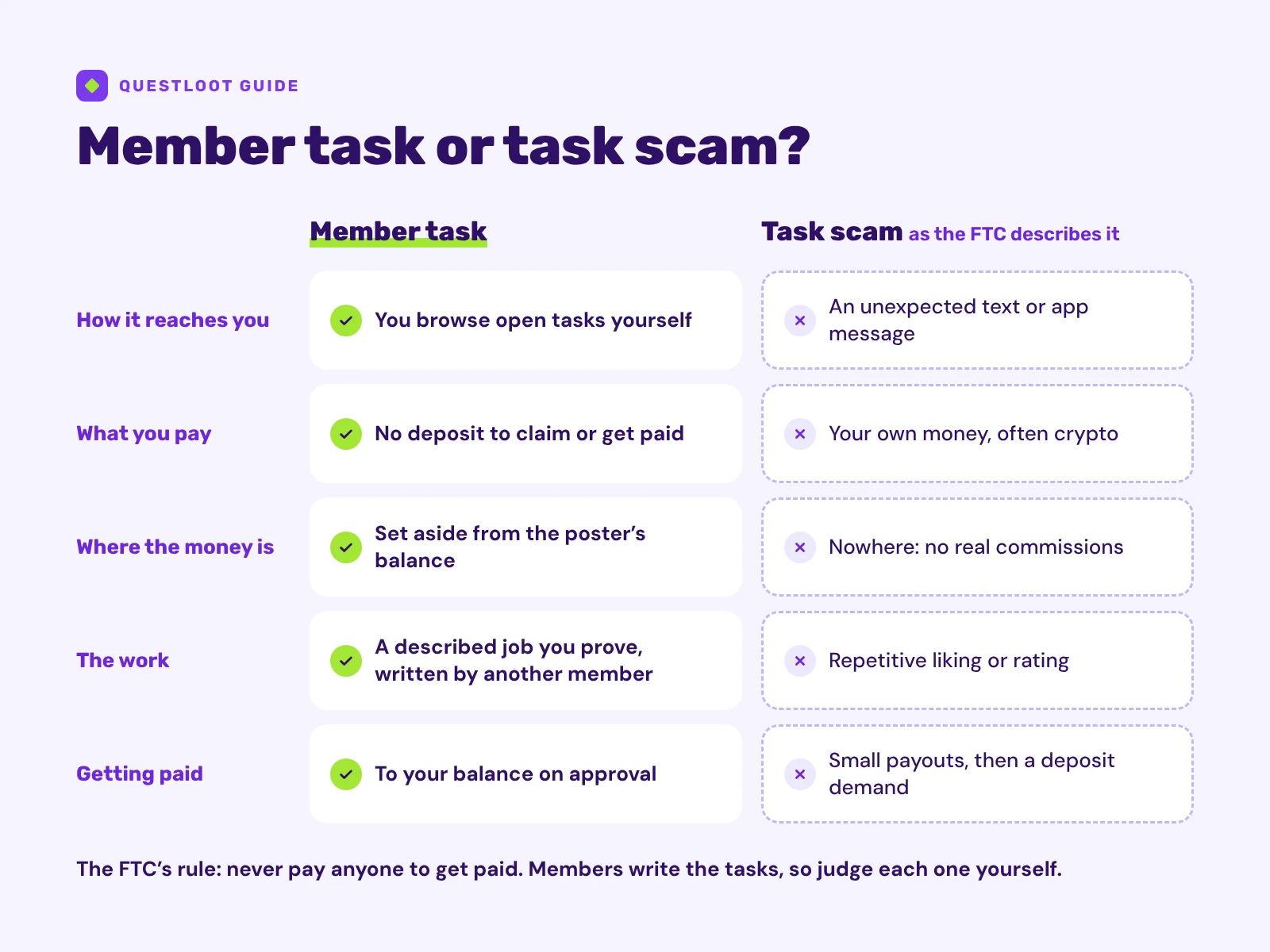 Member task or task scam? Five ways to tell.
| Member task on QuestLoot | Task scam, as the FTC describes it | |
|---|---|---|
| How it reaches you | You browse open tasks on the site yourself | An unexpected message on WhatsApp, Telegram, text or social media |
| What you pay | No deposit to claim a seat or unlock your payout | Your own money, usually crypto, to unlock tasks or withdraw |
| Where the money comes from | The poster's balance, held when the task is posted | Nowhere: the "commissions" don't exist |
| What the work is | A described job you prove, written by another member | Repetitive liking or rating |
| How you get paid | Your balance, once proof is approved | Small early payouts, then fake earnings you can't withdraw |
This contrast is about how payment works. Members write the tasks, so judge each one yourself, and skip any that asks for likes, ratings or money.
The rule that settles it comes from the FTC: "Never pay anyone to get paid, or to get a job. That's a sure sign of a scam." Posting a task on QuestLoot doesn't break that rule, because a poster is paying for work they want done, while the member doing the work never pays anything. If someone messages you about a "task job" and then asks for money, stop replying.
Questions about tasks or payouts? The FAQ covers the identity check and how balances unlock, and you can reach a person through the contact page.
How do task earnings reach your cashout?#
An approved task payout is added to your balance and treated like any other balance. Approved task payouts also count toward unlocking QuestLoot's $2 signup bonus, alongside quests and surveys. When your available balance reaches the minimum for the payout method you want, you can request a cashout from the Cash Out page, where each request is reviewed before it's approved. Our guide to how cashouts work walks through every stage, from the identity check to the payout.
What mistakes cost you a task payout?#
- Claiming a task you can't finish in time. The claim lapses and the seat goes to someone else.
- Sending vague proof. "Done" gives the creator nothing to approve. Show each part of the instructions.
- Doing the task your own way. Proof is judged against the instructions, not against what seemed sensible.
- Letting a denial sit. Fix the problem and resubmit, or flag it if you think the denial was wrong.
- Taking a task off the platform. If anyone asks to pay you or talk about a task somewhere else, it's safest to decline and keep the work on the site, where your payout reaches you through your balance.
- Sharing more than the task needs. Proof should show the work, not your passwords or personal details.
Ready to pick up a task?#
Have a look at the open tasks, pick one with clear instructions you can finish comfortably in the time allowed, and keep your proof as you go.