You earn rewards taking online surveys by answering questionnaires that companies and researchers pay for. A rewards site lists each survey with its estimated length and reward, you answer a few qualifying questions, and if you fit what the survey is looking for, you complete it and the reward is added to your balance. Once your balance reaches the minimum, you cash it out.
Do paid surveys really pay? Yes, but modestly, and the honest answer depends on one thing most guides skip: how much of your time goes into surveys you don't qualify for. This guide explains how surveys work, why you get screened out, how to work out what a survey really pays, what you share with survey sites, and how to spot a scam. You can see how it looks in practice on QuestLoot's surveys.
How do paid surveys work?#
Brands, agencies and researchers want answers from specific groups of people: parents of young children, people who bought a car this year, gamers in a certain country. They buy those answers through survey networks, which find respondents through rewards sites. When you complete a survey, the network pays the site, and the site passes part of that payment to you as your reward.
On QuestLoot, every survey shows its estimated length and its reward before you start. The reward shown is what you get for completing it. Surveys come through third-party survey networks, currently CPX Research, ayeT-Studios and Prime Earn, so the survey itself opens on the network's pages.
Good to knowA survey reward is added once the network confirms your completion, not the moment you see the last page. On some networks that can take a few minutes, and the network's confirmation is what counts.
Why do you get screened out of surveys?#
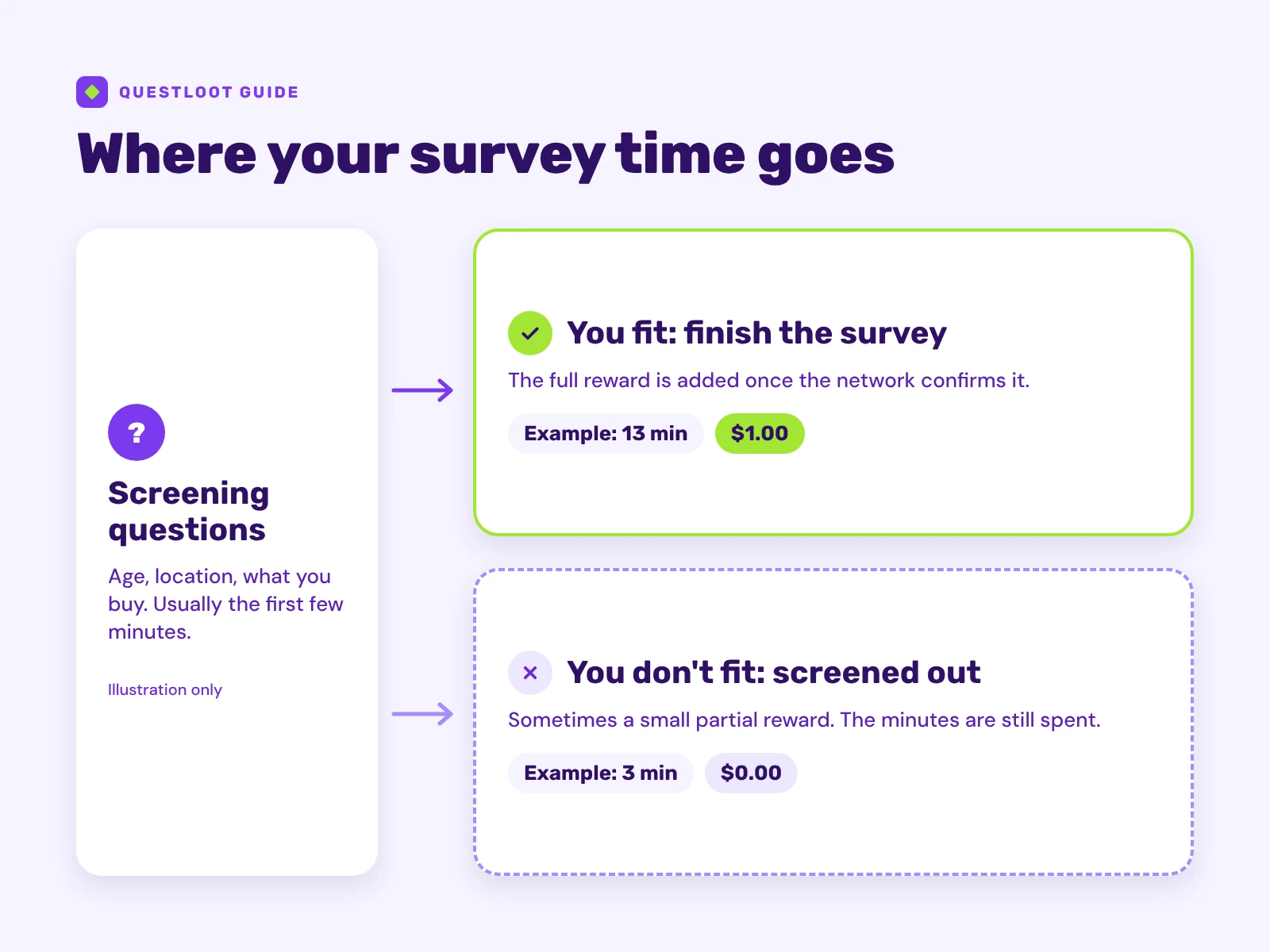 Example times only. Screen-outs still use up minutes.
Most surveys start with a few screening questions, such as your age, where you live, or what you've bought recently. A survey looking for, say, 300 recent car buyers in Texas has no use for anyone else, and once it has enough people in a group, that group's quota is full. If your answers don't match what the survey still needs, you're screened out, usually within the first few minutes.
Screen-outs are normal and they don't mean you did anything wrong. On QuestLoot, a survey you don't qualify for partway through sometimes still pays a small partial reward, but you shouldn't count on it. The real cost of a screen-out is the minutes you've already spent, which is why it belongs in any honest calculation of what surveys pay.
Never try to guess your way into a survey. Answers that contradict each other, or contradict what you said in an earlier survey, can lead a network to reject a completion or show you fewer surveys.
What does a survey session look like?#
Here's a made-up example of a short session. The surveys, lengths and rewards are invented to show the pattern, not to predict what you'll see:
| Survey (length · reward shown) | What happened | Minutes spent | Reward earned |
|---|---|---|---|
| A · 10 min · $0.80 | Screened out | 3 | $0.00 |
| B · 15 min · $1.20 | Screened out | 5 | $0.00 |
| C · 12 min · $1.00 | Completed | 13 | $1.00 |
| Total | 21 | $1.00 |
Example only, with invented surveys and times. Not typical results or a benchmark.
Nothing went wrong here, apart from survey C running a minute over its estimate. Two surveys didn't need someone like this respondent, and the third did.
How do you work out what a survey really pays?#
Divide what you earned by every minute you spent, including the screen-outs, not just the length of the survey you finished.
- On paper: survey C pays $1.00 for about 12 minutes, so $1.00 ÷ 12 ≈ $0.08 for each minute.
- Counting the screen-outs: the session paid $1.00 for 21 minutes, so $1.00 ÷ 21 ≈ $0.05 for each minute.
In this example, screen-outs cut the return for your time by more than 40%. That's why the highest reward on the list isn't always the best choice. A survey you're likely to qualify for, at a reward you're happy with, often beats a bigger one you probably won't get through. Try the calculation on your own first few sessions. It tells you far more than any headline number.
How to earn rewards taking online surveys, step by step#
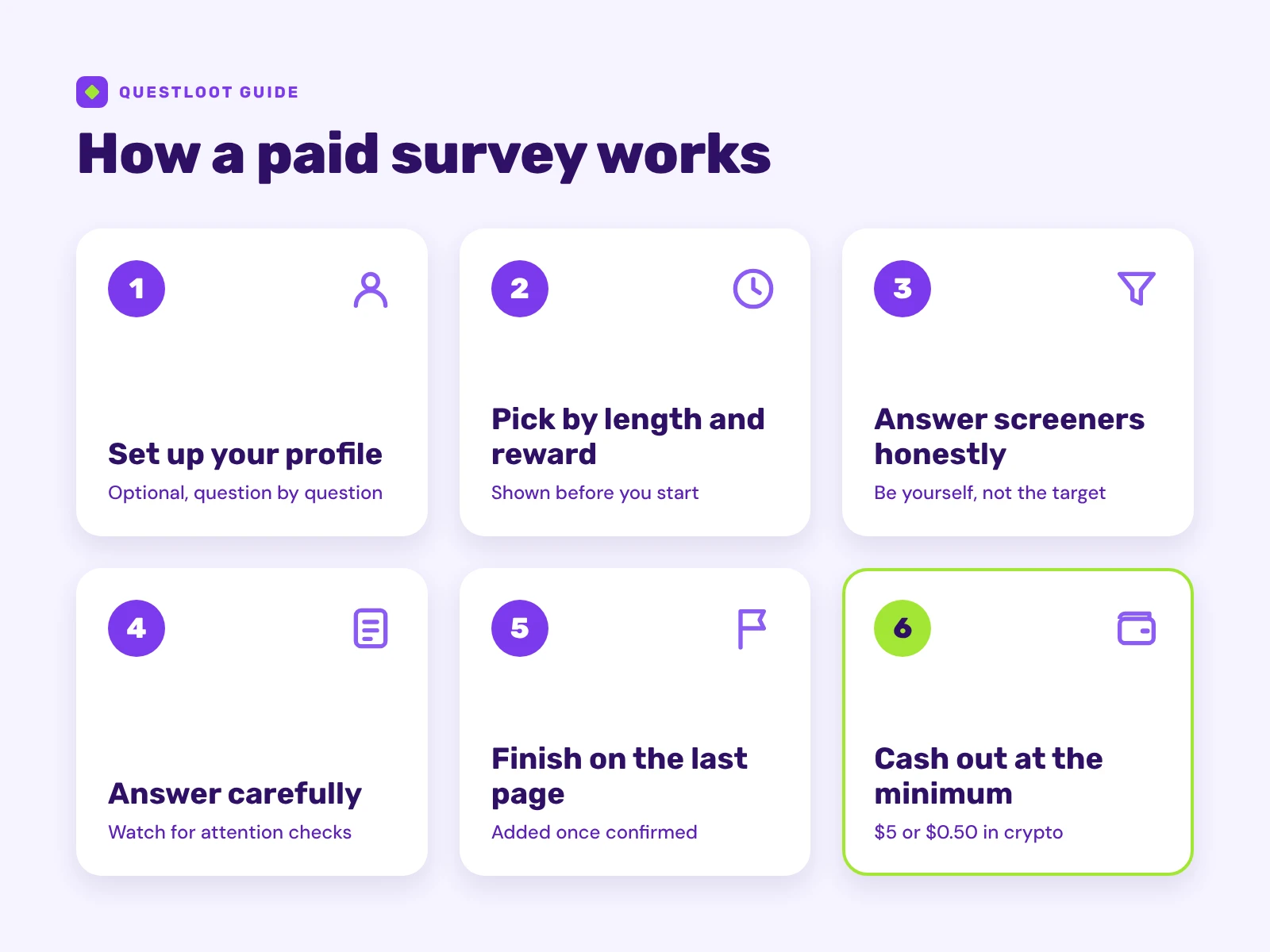 How a paid survey goes from first click to cashout.
Step 1: Join and decide on your survey profile#
After you join QuestLoot, the surveys page offers an optional survey profile: a few questions such as your date of birth, gender, country and ZIP or postal code. Networks use these answers to match you with surveys. You choose, question by question, whether to share each one, and you can skip the profile entirely. The section on privacy below explains what happens to those answers.
Step 2: Pick a survey by length and reward#
Every survey shows its estimated length and reward. Once you're signed in, you can sort the list by quickest or highest paying. Start with surveys that fit the time you actually have, because quitting halfway through means no reward.
Step 3: Answer the screening questions honestly#
Answer the qualifying questions as yourself, not as the person you think the survey wants. Honest, consistent answers are what get you into the surveys you genuinely fit, and they keep your completions from being rejected later.
Step 4: Answer carefully, not just quickly#
Read each question. Many surveys include attention checks, such as "select 'strongly disagree' for this question", and they can end a survey early if you rush. Keep your answers consistent with your profile and with what you said earlier in the same survey.
Step 5: Finish on the last page#
Keep going until the survey's last page. With some networks, such as Prime Earn, you then return to QuestLoot and see either "Survey complete" or "You didn't qualify this time", along with any reward the network reports. Whichever network runs it, a reward is added to your balance once the network confirms it. If you leave before the end, the survey isn't complete and there's no reward.
Step 6: Cash out when you reach the minimum#
On QuestLoot the minimum is $5 (in whole dollars) for gift cards, PayPal and prepaid cards, or $0.50 for a crypto payout. You can request one cashout every 24 hours, and before your first one you complete a one-time identity check. Every cashout goes through a flexible, risk-based review process and is typically processed within 24 hours. The Cash Out page explains the payout methods, and once you're signed in it shows the ones available to your account. Survey rewards also count toward unlocking the $2 signup bonus, which unlocks $0.50 for every $2 you earn.
How do you choose surveys worth your time?#
- Match the length to the time you have. A 20-minute survey you abandon at minute 15 earns nothing.
- Weigh the reward against the length. Compare surveys on reward ÷ minutes, not on the reward alone.
- Ask whether you're likely to fit. A survey about a product you've never used, or a group you're not in, will probably screen you out.
- Notice your screen-out rate. If you're screened out again and again, try shorter surveys, take a break, or check that your profile answers are still accurate.
- Skip it if you can't concentrate. Rushed answers fail attention checks and can get completions rejected. Coming back later is fine.
What do you share with survey sites, and how do you control it?#
This is the part of survey sites most guides skip, so here's exactly how it works on QuestLoot, from our privacy policy:
- Always shared, profile or not: when you open the Surveys page, QuestLoot sends each survey network your internal account ID, your IP address and your browser's user-agent details, so it can return the surveys you can take.
- The survey profile is optional. You can browse and complete surveys without it, though surveys may be less well matched to you.
- What it asks: your date of birth, gender, country and ZIP or postal code. Employment status, industry and role may be added as networks begin to use them, and you'd be asked about each one separately.
- Who receives your profile answers: only the survey networks QuestLoot works with, and only with your explicit consent, given question by question. Each network receives only the answers it can use.
- How to change your profile: you can view, change or delete your answers, and withdraw your consent, at any time in Settings > My Data. That stops any further sharing.
- What you can't undo automatically: profile answers a network has already received are held by that network under its own privacy policy. To ask a network to delete them, contact that network, or contact QuestLoot support and we'll help with the request.
Inside the surveys themselves, share only what the question needs. No legitimate survey asks for your passwords, your full card number or your bank login.
What mistakes cost you survey rewards?#
- Inconsistent answers. Saying you're 34 in the screener and 41 later is a quick way to get a completion rejected.
- Rushing. Speeding through and failing attention checks can end a survey early or void the reward.
- Leaving before the end. A survey you close before its last page isn't complete.
- Chasing the biggest reward. Long, high-paying surveys you rarely qualify for can waste more time than they pay.
- Using a VPN or proxy. It can stop surveys working properly, and QuestLoot's terms don't allow using one to mask your location.
What should you do if a survey reward is missing?#
- Check how the survey ended. If it screened you out, even late, there's no full reward. With some networks, such as Prime Earn, the screen you return to says so: "You didn't qualify this time".
- Give the network a little time to confirm the completion.
- Note the details: the survey's reward and length, the time you finished, and a screenshot of the survey's last page if you have one.
- Contact support through the contact page with those details. Never send passwords or more personal information than support asks for.
QuestLoot credits your balance once the network reports a completion. If it doesn't, support makes a reasonable effort to resolve it with the network for you, but the outcome isn't certain. The FAQ also answers questions about missing rewards and cashouts.
Are paid surveys legit?#
Many survey sites are, but paid surveys are also a favorite disguise for scams. A legitimate survey site is free to join and shows you each survey's reward before you start. Walk away if a site or "survey job":
- charges you to join, or to unlock or cash out your rewards,
- asks for your card number, bank login or passwords to sign up or get paid,
- sends you a check to deposit and asks you to send part of it back or buy gift cards with it,
- promises big money for a handful of surveys, or pressures you to sign up right now.
Two FTC alerts back these up: its side-hustle scam advice warns about big money for little effort, pressure and upfront payments, and its mystery-shopping alert walks through the check-and-gift-card trick. If you want to check QuestLoot itself, we've set out how to check whether QuestLoot is legit, including how cashouts are reviewed.
How much can you realistically earn from surveys?#
There's no figure worth quoting, because it comes down to four things: how many surveys are offered to you, how often you qualify, how long they take, and how carefully you answer. The session calculation above is your best guide, because it uses your own screen-out rate. Treat surveys as a small extra for spare minutes, not as a job or a reliable income.
Survey rewards may also count as taxable income where you live. For the general US rule, see the IRS's overview of taxable and nontaxable income.
Surveys, game quests or tasks: which should you try?#
| What to compare | Surveys | Game quests | Tasks |
|---|---|---|---|
| Typical time commitment | A couple of minutes or more | Days to weeks of playing | Varies by task |
| What can go wrong | Screen-outs | Tracking and time limits | A submission isn't approved |
| How you're paid | On completion | Milestone by milestone | When your submission is approved |
If you enjoy mobile games and don't mind a longer commitment, game quests pay milestone by milestone, and our guide to earning rewards playing mobile games shows how to work out what a quest really pays. Tasks suit quick, one-off jobs for other members. Plenty of people mix all three.
Ready to try a survey?#
QuestLoot is free to join, and survey rewards count toward your $2 signup bonus. Take a look at the surveys page, set up your profile if you'd like better-matched surveys, and work out your real return over your first few sessions.